The Government Says Support Is in Place for Landlords Before MTD—Here's What the Data Actually Shows
The government's messaging around Making Tax Digital for landlords has been consistent. Support systems are ready. Resources are available. Guidance is accessible. The transition will be smooth.
I've been looking at the actual numbers behind this reassurance. What I'm seeing doesn't match the confident tone coming from policymakers. The gap between what's promised and what's happening on the ground is wider than anyone wants to admit.
Here's what the data reveals about landlord readiness, what the government's support actually consists of, and what you need to understand before April 2026 arrives.
The Awareness Problem Nobody's Talking About
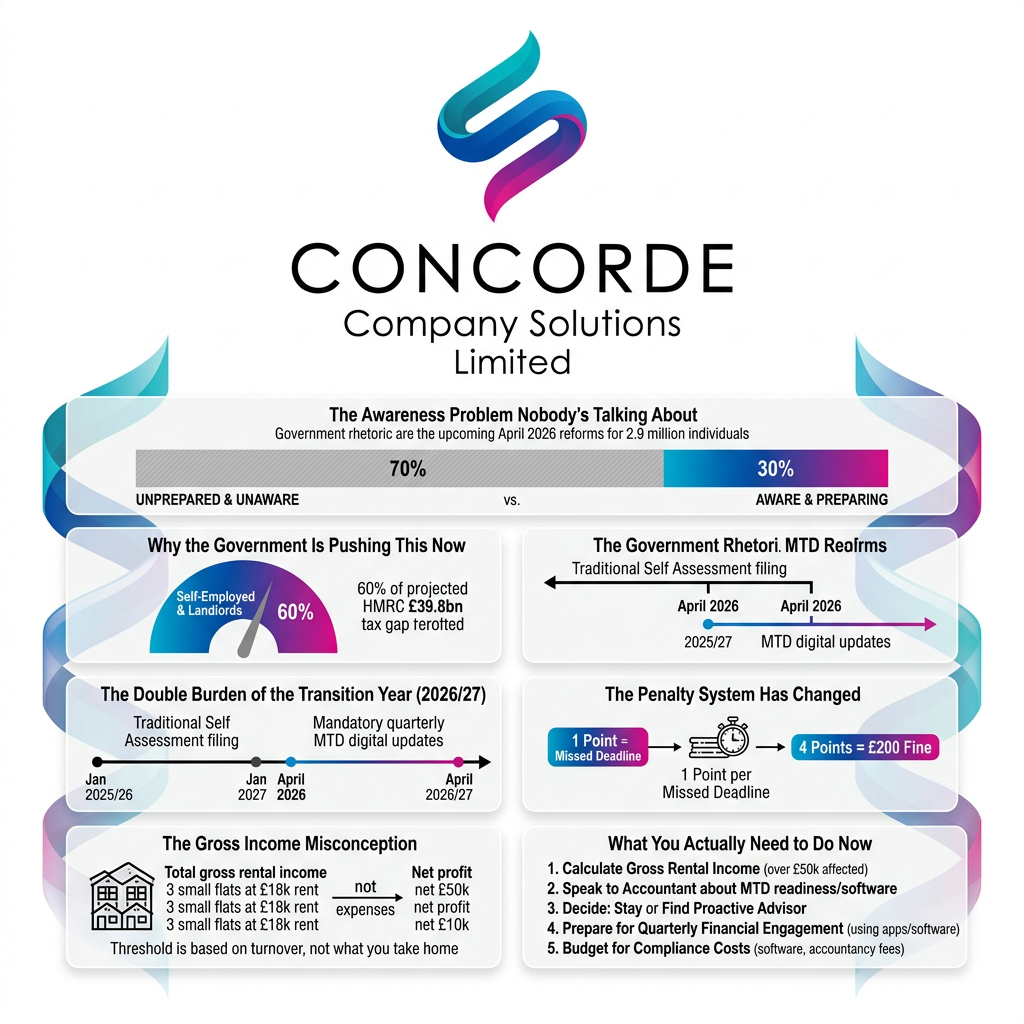
Recent research shows that only 30% of the 2.9 million individuals impacted by MTD are aware of the reforms. That means 70% of people who will be legally required to file quarterly digital updates in just over a year have no idea it's coming.
This isn't a small administrative oversight. This is two million people who haven't started preparing for a fundamental change to how they report rental income. They haven't researched software options. They haven't spoken to their accountants. They haven't budgeted for the additional compliance costs.
The government can point to webinars and guidance documents all day long. If seven out of ten affected landlords don't know MTD exists, the support infrastructure isn't reaching the people who need it.
Why the Government Is Pushing This Now
The context matters here. HMRC estimates the tax gap—the difference between tax owed and tax collected—sits at £39.8 billion. 60% of this gap comes from Self Assessment business taxpayers, which includes landlords.
That's roughly £24 billion in uncollected tax from self-employed individuals and landlords. MTD isn't about modernisation or efficiency. It's about closing that gap. The government believes quarterly digital reporting will reduce errors, eliminate deliberate underreporting, and bring in billions in additional revenue.
I'm not making a moral judgement here. I'm explaining the incentive structure. When you understand why something is happening, you can predict how aggressively it will be enforced. This isn't going away. The government has too much riding on it.
The Double Burden of the Transition Year
Here's something most landlords don't realise yet. In the first year of MTD, you'll need to complete both the new quarterly digital updates and your traditional Self Assessment tax return for the previous year.
If you start reporting under MTD in April 2026 for the 2026/27 tax year, you'll still need to file a traditional Self Assessment return by January 2027 for the 2025/26 tax year. That's two completely different reporting systems running simultaneously.
This is where the administrative burden becomes real. You're not just learning new software and adapting to quarterly deadlines. You're maintaining two parallel compliance processes for an entire year. One backward-looking using the old system, one forward-looking using the new one.
The government's support materials mention this reality, but they don't emphasise how demanding it will be for landlords managing multiple properties whilst running other businesses or working full-time jobs.
The Penalty System Has Changed—and It's Stricter
HMRC has introduced a new points-based penalty system for MTD that rewards consistency over one-off compliance. Here's how it works: you accumulate one penalty point for every missed quarterly deadline. Once you hit four points, you trigger a £200 fine.
This is different from the old system where you might get away with occasional late filings without serious consequences. The new approach is cumulative. Miss four deadlines over the course of a year, and you're paying penalties regardless of whether you eventually file everything correctly.
There is some relief built in. For the 2026/27 tax year only, HMRC won't penalise late quarterly updates. But this breathing room doesn't apply to your end-of-year tax return for 2026/27, which is due by 31 January 2028. That deadline still carries full penalties.
The message is clear. HMRC will give you one year to learn the system, but they expect full compliance after that. The penalty structure is designed to punish inconsistency, not just non-compliance.
The Gross Income Misconception
The £50,000 threshold for MTD applies to gross rental income, not profit. This trips people up constantly. Gross means total rental income before you deduct mortgage interest, repairs, letting agent fees, or any other expenses.
If you own three small flats generating £18,000 each in annual rent, you're caught by MTD even if your actual profit after all expenses is £15,000. The threshold is about turnover, not what you take home.
I've seen landlords assume they're safe because their profits are modest. Then they add up their total rents and realise they're over the line. This is particularly common with landlords who've built portfolios gradually over years without tracking their cumulative gross income.
The government's guidance explains this distinction, but it's buried in technical documentation. Most landlords won't discover the reality until they sit down with an accountant and actually calculate their gross rental income properly.
What Forward-Thinking Practices Have Already Done
The accountants who saw this coming two years ago have already invested in MTD-compatible software. Xero, Sage, and specialist property platforms like RentalBux are all HMRC-recognised for MTD compliance.
This infrastructure investment matters because it means some practices can onboard landlords into MTD-ready systems right now, well ahead of the April 2026 deadline. Clients don't need to scramble at the last minute. They don't need to learn new software under pressure.
The practices that haven't prepared yet will face a bottleneck in late 2025 and early 2026 as panicked landlords all try to get compliant simultaneously. Software providers will be overwhelmed. Accountants will be stretched thin. Costs will likely increase due to demand.
If your accountant hasn't mentioned MTD yet, that tells you something about their forward planning. The information has been available for years. The deadline isn't a surprise.
What You Actually Need to Do Now
Calculate your total gross rental income across all properties. Not your profit—your total rents received. If you're over £50,000, you're affected.
Speak to your accountant about their MTD readiness. Do they have compatible software in place? Have they onboarded other landlords already? What's their timeline for getting you set up?
If your accountant seems vague or unprepared, you need to make a decision about whether to stay with them or find someone who's already implemented MTD systems. This isn't the time for loyalty to outweigh competence.
Understand that quarterly reporting means quarterly engagement with your finances. You can't leave everything until January anymore. You'll need to capture receipts and invoices throughout the year, ideally using apps that feed directly into MTD-compatible software.
Budget for additional costs. Whether it's software subscriptions, increased accountancy fees, or time spent learning new systems, MTD will cost you something. Factor that into your rental business economics now rather than being surprised later.
The Support That Actually Exists
HMRC has published guidance documents, created webinars, and established helplines for MTD queries. These resources exist. They're accessible. But they're generic.
What landlords actually need is specific advice tailored to their individual property portfolios, their existing accounting systems, and their personal circumstances. A webinar explaining MTD basics doesn't tell you whether you should restructure your property ownership, how to handle a portfolio split between personal and limited company ownership, or which software works best for your situation.
The government's support infrastructure provides information. It doesn't provide advice. That distinction matters enormously when you're trying to navigate a complex regulatory change with financial consequences.
Your accountant should be providing that advice. If they're not, you're relying on government resources that were never designed to replace professional guidance.
What Happens If You Ignore This
Some landlords will ignore MTD until they receive enforcement letters from HMRC. This is a terrible strategy, but it's predictable given the low awareness numbers.
HMRC has significant enforcement powers. They can charge penalties, impose interest on late payments, and ultimately pursue legal action for persistent non-compliance. The points-based penalty system is specifically designed to catch people who think they can file late occasionally without consequences.
More importantly, last-minute compliance is expensive and stressful. You'll pay premium rates for rushed accountancy work. You'll make mistakes because you're learning systems under pressure. You'll miss opportunities for tax efficiency because you're focused on basic compliance rather than strategic planning.
The landlords who treat MTD as an urgent priority now will have smooth transitions. The ones who wait will have chaotic ones. The government's support materials won't change that reality.
The Pattern I'm Seeing
Across the landscape of small business taxation, I'm watching a consistent pattern emerge. The government announces digital reforms years in advance. They publish guidance and create support resources. Then they're surprised when actual compliance rates are low until the deadline approaches.
This happened with MTD for VAT. It's happening again with MTD for Income Tax. The gap between policy announcement and individual action is enormous because most people don't engage with tax compliance until they absolutely have to.
The landlords who will navigate MTD successfully are the ones who recognise this pattern and act against it. They're preparing now whilst there's time to make considered decisions rather than rushed ones.
The government's support is in place in the sense that information exists. But information isn't the same as readiness, and readiness isn't the same as successful implementation.
What's your current level of preparation for MTD? Have you calculated whether you're affected, or are you still assuming it doesn't apply to you?